---
title: 'The Fermat''s principle F'
media_order: stationnarite3_650.jpg
published: false
routable: false
visible: false
---
!!!! *IN CONSTRUCTION !*
!!!!
!!!! *very imperfect course,*
!!!i *not validated by the teaching team*
-------------
### Fundamentals of geometric optics
#### Geometric optics:
a simple physical model.
Its *fundamentals* are:
* The concept of **light ray** : oriented trajectory of light energy
* The concept of **refractive index** : characterizes the apparent speed of light in a homogeneous medium
* The **Fermat's principle**
##### Ray of light

[AUDIO : _the intuition of the "ray of light" during a walk in the forest_](OG_rayons_foret.mp3)
The **light rays** are *oriented lines* that in each of their points indicate the *direction of propagation of the luminous energy*.
The light rays follow *straight lines in a homogeneous medium*.
Light rays *do not interact with each other*
##### The refraction index
**Refractive Index $`n`$**
**$`n \; = \; \dfrac{c}{v}`$**
* **`c`** : *speed of light in vacuum* (absolute limit)
* **`v`** : *speed of light in the middle* homogeneous
**$`\Longrightarrow \: : \: n`$** : physical dimension **without dimension** and **always > 1**.
Dependency : **$`n \; = \; n (\nu) \; \; \; `$**, or **$` \; \; \; n \; = \; n (\lambda_0) \; \ ; \; `$** *(with $`\lambda_0`$ wavelength in vacuum)*
!! TO GO FURTHER :
!!
!! over the entire electromagnetic spectrum and for any medium:
!! $`n`$: complex value dependent on the $\nu$ frequency of the electromagnetic wave, strong variations representative of all light / matter interaction mechanisms: $`n (\nu) = \Re[n(\nu )] + \Im[n(\nu)]`$
!!
!! In the visible domain (where $`\lambda_0`$ is more used than $`\nu`$) and for transparent medium :
!! real value, small variations of $`n`$ with $`\lambda_0`$ $`\left(\frac{\Delta n}{n} < 1\%\right)`$
##### Optical path
**optical path** *$`\delta`$* $`=`$
**euclidean length** *$`s`$* $`\times`$ **refractive index** *$`n`$*
* **$`\Gamma`$** : *path (solid line) between 2 fixed points A and B*
* **$`\mathrm{d}s_P`$** : *element of infinitesimal length at point P on path $`\Gamma`$*
* **$` n_P`$** : *refractive index at point P*
* **$`\mathrm{d}\delta_P`$** : *infinitesimal optical path at point P on path $`\Gamma`$*
Optical path along a path between 2 fixed points A and B :
**$`\delta\;=\;\displaystyle\int_{P \in \Gamma}\mathrm{d}\delta_P\;`$$`=\;\displaystyle\int_{P \in \Gamma}n_P\cdot\mathrm{d}s_P`$**
* **$`\delta`$** $`=\displaystyle\int_{\Gamma}n\cdot\mathrm{d}s\;=\;\int_{\Gamma}\dfrac{c}{v}\cdot\mathrm{d}s`$ = $`c\;\displaystyle\int_{\Gamma}\dfrac{\mathrm{d}s}{v}`$ = *$`\;c\;\tau`$*
* **$`\delta`$** is *proportional to the travel time*.
#### Optical path
**optical path** *$\delta$* $=$
**euclidean length** *$s$* $\times$ **refractive index** *$n$*
* **$\Gamma$** : *path (solid line) between 2 fixed points A and B*
* **$\mathrm{d}s_P$** : *element of infinitesimal length at point P on path $\Gamma$*
* **$ n_P$** : *refractive index at point P*
* **$\mathrm{d}\delta_P$** : *infinitesimal optical path at point P on path $\Gamma$*
Optical path along a path between 2 fixed points A and B :
**$\delta\;=\;\int_{P \in \Gamma}\mathrm{d}\delta_P\;=\;\int_{P \in \Gamma}n_P\cdot\mathrm{d}s_P$**
* **$\delta$** $=\int_{\Gamma}n\cdot\mathrm{d}s\;=\;\int_{\Gamma}\frac{c}{v}\cdot\mathrm{d}s$ = $c\;\int_{\Gamma}\frac{\mathrm{d}s}{v}$ = *$\;c\;\tau$*
* **$\delta$** is *proportional to the travel time*.
#### Stationarity
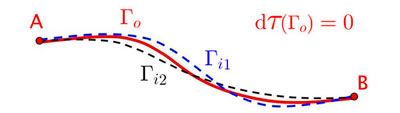
* **$\Gamma_o$** : *path between two fixed point A and B*
* **$\lambda_i$** : *parameter that defines a path*
* **${\Large\tau}$** : *grandeur physique caractérisant un chemin*
**${\Large\tau}(\Gamma_o)$ stationnaire
${\Longleftrightarrow}\:\:\:\:\:\mathrm{d}{\Large\tau}(\Gamma_o)=\sum_i\frac{\partial{\large\tau}}{\partial\lambda_i}(\Gamma_o)\;\mathrm{d}\lambda_i=0$**
#### Fermat's principle
**Between two points** of its path, a **ray of light** follows **the path(s)** that present(s) a *stationary travelling time*.
or (equivalent )
**Between two points** of its path, a **ray of light** follows **the path(s)** that present(s) a *stationary optical path*.
#### Examples
##### Spherical concave mirror
* **A** : *point source* that emits or diffuses lights in all directions.
* **B** : *fixed point in space*.
For this mirror, **according to the positions of points A and B** :
* **several extrema** : here *2 maxima* et *1 minimum* **$\Longrightarrow$ several ligh rays**from A go through B : here *3 rays* :

!!!! *Be careful* :
!!!! Understand this example of application of Fermat's theorem. It says that *the 3 trajectories drawn between A and B satisfy the Fermat's principle* and therefore *are possible trajectories between these two points* to the exclusion of any other trajectory. If point A is a point source that emits light in all directions, then these 3 paths will be followed by light. If a ray goes through A with one of these 3 directions, then the corresponding trajectory will be realized.
!!!! *But* the points *A and B are not conjugate points within th meaning of paraxial optics* : B is not the image point of point source A, and vice versa.
!!! It is the same for all the animations of this chapter "examples".
* other positions of A and B : **1 minimum $\Longrightarrow$ 1 unique ray** from A goes trhough B .

* other positions of A and B : **1 maximum $\Longrightarrow$ 1 unique ray** from A goes trhough B .

##### Elliptical concave mirror.
* Elliptical mirror : mirror whose surface is part of an ellipsoid of revolution.
!
!
! Ellipsoid and ellipsoid of revolution
!
! Est-il nécessaire de rapeller ici ce que sont les ellipsoïde et ellipsoïde de révolution? rappel en texte? ou 2 liens vers Wikipédia? ou lien vers une autre page m3p2 sur les quadriques en géométrie euclidienne (page encore à créer) ? Si oui, dans une partie Beyond, parler du miroir elliptique concave acoustique, c'est impressionnant quand on le vit.
!
* **between the two geometrical foci"** F et F' of an elliptical mirror, **all path are stationary** : they have the same optical path
**$\Longrightarrow$** : *all the rays coming from one of the two foci and intercepting the mirror converge towards the second geometric focus *.

!!!! *BE CAREFUL* :
!!! the "geometric foci" of the ellipsoid of revolution, the "geometric surface" in which the surface of the elliptical mirror is inscribed, do not correspond to the optical foci (the two focal points) of the elliptical mirror as they will be defined in the "optical sense" of the word "focus" in the remainder of this course.
'The 4 laws of geometrical optics'
---
* **Fermat's principle** *$\Longrightarrow$ the 4 laws of geometrical optics* :
#### Law of reversibility of the path of light.
Optical path and property of stationarity : concept of orientation not used
*$\Longrightarrow$ stationarity property does not depend on the orientation* of the path.
**$\Longrightarrow$** the **trajectory** *followed by the light* is **indépendant of the direction of propagation along the trajectory**.
#### Law of the rectilinear light trajectory in homogeneous and isotrope media.
Euclidian space : *straight line = shortest path between 2 points*
**$\Longrightarrow$** in an **optically homogeneous and isotrope medium**, the *light travels rectilinearly* : the **light rays are straight lines**.
#### The 2 laws of reflection and refraction
!
!
! IF NECESSARY : reminder if the definitions of the angles and refractive indexes used below.
!
! $n_{incid}$ : refractive index of the incident light medium.
! $n_{émerg}$ : refractive index of the emergent light medium (so after crossing the surface).
! $i_{incid}$ : incident ray - normal to the surface at the point of impact angle.
! $i_{émerg}$ : emergent ray - normal to the surface at the point of impact angle.
!
For any incident ray impacting a surface :
* The **surface at the point of impact** is *locally a plane*.
* **Plan of incidence** : plane that *contains the incident ray and normal to the surface at the point of impact*.
* **Refracted and reflected rays** are *in the plane of incidence*, on the *side opposite to the incident ray in relation to the normal* at the surface at the impact point.
*Reflection law* : **$i_{réflec} = i_{incid}$**
*Refraction law (Snell-Descartes)* : for any $i_{incid}$ :
* if $\dfrac{n_{incid}}{n_{émerg}}\cdot\sin(i_{incid})\leqslant1$ then **refraction phenomenon** :
**$n_{émerg}\cdot sin(i_{émerg})=n_{incid}\cdot sin(i_{incid})$**
* if $\dfrac{n_{incid}}{n_{emerg}}\cdot\sin(i_{incid})>1$ then **total reflection phenomenon** :
*reflected ray* on the interface that follows the reflection law **$i_{réflec} = i_{incid}$**
* **Critical angle** (of inidence) **for total reflection : $i_{incid_limit}=\arcsin\left (\dfrac{n_{émerg}}{n_{incid}}\right)$** *$\Longrightarrow i_{émerg}=\pi/2\:rad = 90 °$*
_Phenomena of reflection and refraction on a refracting surface._

!!
!!
!! TO GO FURTHER : intensity distribution between reflected and transmitted beam at a refracting surface.
!!
!! Geometrical optics: does not quantify the reflected $R$ and transmitted $T$ parts of the incident beam intensity at a plane refracting surface. This distribution varies according to the incidence angle, the polarization of the incident light, the wavelength. This is described by electromagnetism.
!! However a simple result is useful and to know :
!! *The light intensity is either reflected or transmitted* : $R+T=1$.
!!
!! For a light beam of wavelength $\lambda$ of normal incidence upon a refracting surface :
!! - ratio reflected power versus incident power : $R=\left(\dfrac{n_{incid}-n_{émerg}}{n_{incid}+n_{émerg}}\right)^2$
!! - ratio transmitted power versus incident power : $T=1-R$
!!
_Total reflection phenomenon_
