---
title: lens-overview
media_order: 'lens-convergent-N3-en.jpeg,lens-divergent-N3-en.jpeg,Const_lens_conv_point_AavantF2.gif,thick-lens-water-air.gif,Lentille_epaisse_Gauss_incl_v1.gif,2-centered-refracting-surfaces-1-all.gif,2-refracting-surface-physical-system.jpeg,2-centered-refracting-surfaces-direction-axis.gif,Lentille_epaisse_principe_ok.gif,lentille_relle_representation_v1.gif,Const_lens_conv_point_AapresO.gif,lens-convergent-N3-es.jpeg,lens-convergent-N3-fr.jpeg,lens-divergent-N3-es.jpeg,lens-divergent-N3-fr.jpeg'
---
### Two successive and centered spherical refracting surfaces
!!! *WHERE YOU ARE* :
!!! Observation $\Rightarrow$ Geometrical optic interpretation $\Rightarrow$ Fermat's Principle $\Rightarrow$ The 5 optical laws $\Rightarrow$ Paraxial approximation $\Rightarrow$ Simple optical element $\Rightarrow$ System of 2 simple optical elements.
! *THIS CHAPTER AIMS AT* :
! * Deeply understand and better master thin lenses.
! * Understand when the lens equation and the coresponding transverse magnification expression can be used, and when they are not correct.
! * Understand need and requirement of new concepts to master esaily and efficientlynext main chapter "Centered optical systems".
*Two successive and centered spherical refracting surfaces* = **thick lens**
##### Thick lens as a physical system
**Physical system** = *spatial distribution of the refracting indexes values* (_variations of refracting index can be discontinuous with interfaces (_refracting surfaces, lenses, mirrors_) or continuous (graded-index optical fiber)_.
**Optical system** = *oriented physical system* = *physical systems + bodies (1) + a direction (2)*
* (1) : which emit, diffuse or reflect the ambiant light.
* (2) : direction of light propagation considered through the physical system.
**Difference** between physical and optical system in optics :
Example of the lensball :
Physical system of a lensball :
**Thick lens** physical system :
Most general : *3 different transparent media with their own refractive index values*, and *2 local spherical interfaces* that separate these media, and *centered on the straigth line* that joins their centers of curvature._
**Examples** in images :

##### Thick lens as an optical system
**Optical system** = *oriented physical system* = *physical systems + bodies (1) + a direction (2)*
* (1) : which emit, diffuse or reflec the ambiant light
* (2) : direction of light propagation considered through the two refracting surfaces.
*From physical system to optical system* : **a scenario to build** :
* Where is the object that is imaged ?
* In what direction are we searching for images ?
* what are the reflecting or refracting interfaces we take into account.
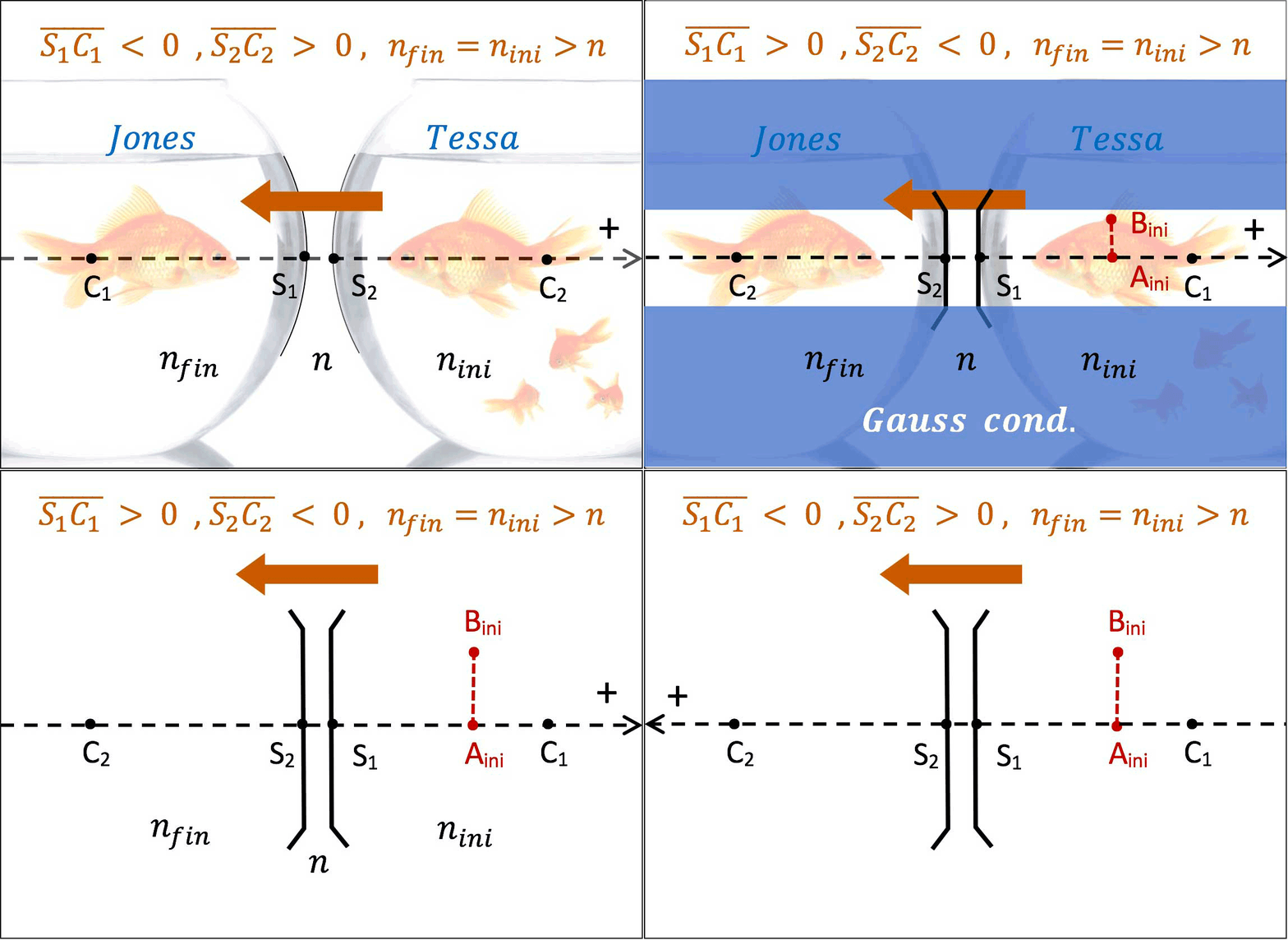
_The physical system consists of two bubble aquariums side by side. In each of them, a fish, and the two fish, Jones and Tessa face each other. These two situations correspond to two optical systems: "Tessa looks at Jones" and "Jones looks at Tessa" (the order of crossing of the refracting surfaces by the light is reversed in both cases). In the situtation we want to describe, the direction of the light is indicated (the brown arrow in the figures)_
**Graphical representation** (drawing) and **analytical representation** (*3 algebraic distances* : 2 radius of curvature $\overline{S_1C_1}$, $\overline{S_2C_2}$,+ distance between the two vertices of the refracting surfaces $\overline{S_1S_2}$ *when used in the paraxial (or same, gaussian) approximation, so when considered in paraxial optics.
_ In order to identify conjugated points, to construct the final image of a specific object for example, the optical axis of the optical system is plotted, vertices and centers of curvature of spherical refracting surfaces are localised on the optical axis. Because
!!! Thick lens





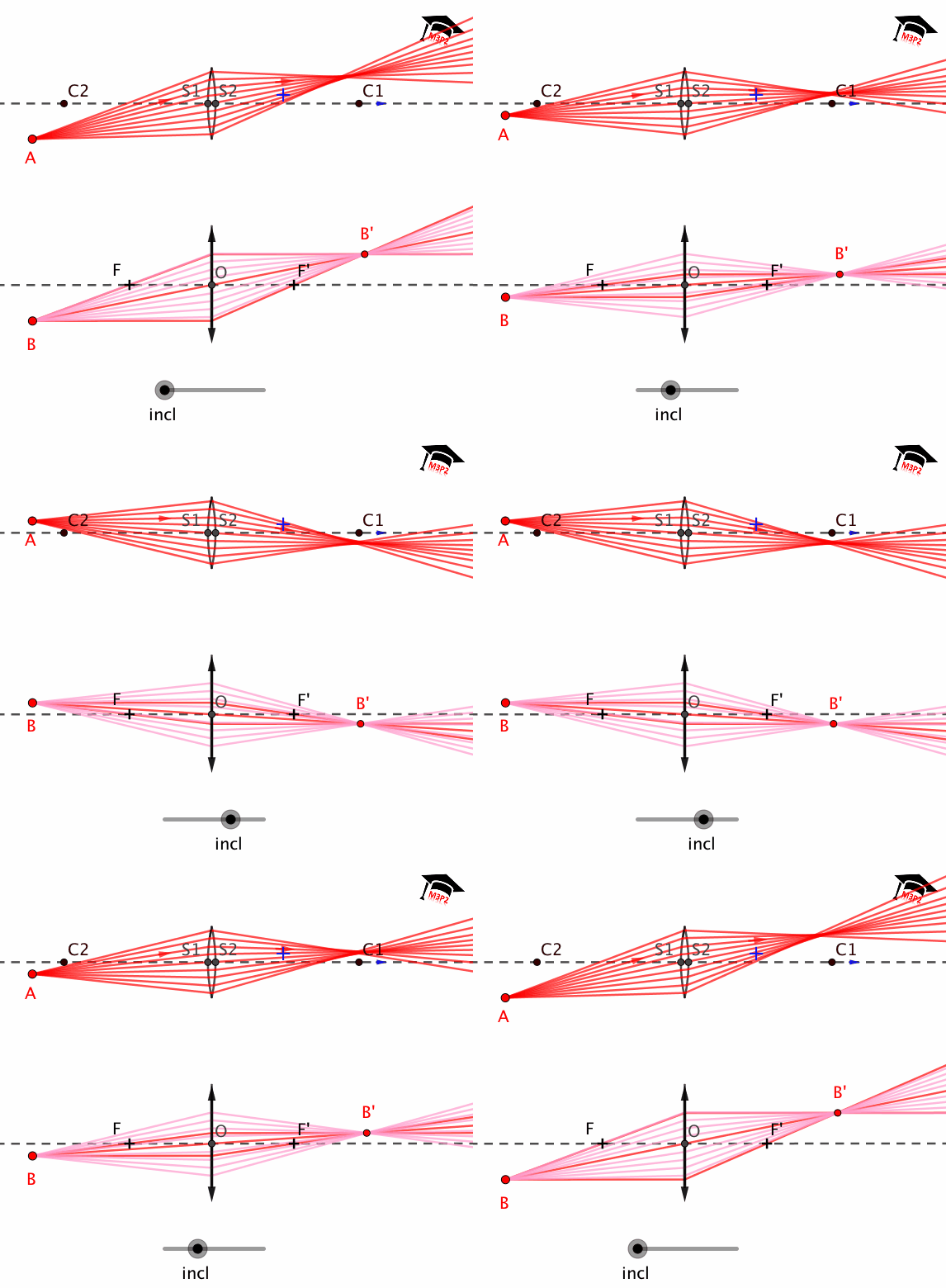
### The thin lens
##### Objective
to **focuse or disperse the light**,
with often the final goal, alone or as part of optical instruments, to **realize images**.
##### Physical principle
**uses the refractive phenomenon**, described by the Snell-Descartes' law.
##### Characterization of its efficiency
(efficiency to realize its objective)
**Vergence** = **dioptric power** V of the lens :
* **unit** : in S.I. : the *diopter*, of symbol $\delta$
1 diopter = 1 $\delta$ = 1 $m^{-1}$).
* **positive vergence** ($V>0)\:\Longleftrightarrow$ *light focalisation : convergent lens*.
* **negative vergence** ($V<0)\:\Longleftrightarrow$ *light dispersion : divergent lens*.
* **absolute value** of the vergence ($|V|$) : *increases as the optical phenomenon (focalisation or dispersion) increases* (as the corresponding deviation of light rays increases).
* **interest** : The *total vergence* of several __contiguous thin lenses__ is the *sum of the vergences of each of the lenses* : $V=\sum V_i$.
or (equivalent)
**image focal length** $f'$ of the lens :
* **positive $f'$** ($f'>0)\:\Longleftrightarrow$ *focuses light : convergent lens*
* **negative $f'$** ($f'<0)\:\Longleftrightarrow$ *disperse light : divergent lens*
* **absolute value of $f'$** ($|f'|$) : *decreases as the optical phenomenon (focalisation or dispersion) increases*.
* **interest** : For thin lenses, the **algebraic value of $f'$** give the *position of the plane* (perpendicular to the optical axis) and from the lens center *where the image of an object at infinity takes place*.
! Nearby in all application, same medium (same refractive index) in both sides of the lens :
! $\Longrightarrow$ object focal lenght $f$ is the opposite of image focal length $f'$ : $f=-f'$
! $\Longrightarrow$ only absolute value $|f'|$ of $f'$ is given, and the lens is specified to be convergeng or divergent.
**Relation between vergence (dioptric power), image and object focal lengthes**
if the refractive index $n_{ini}$ of the medium in which the incident light on the lens propagates, and $n_{fin}$ of the medium in which the light emerges from the lens, then :
$V=-\dfrac{n_{ini}}{f}=+\dfrac{n_{fin}}{f'}$
##### Constitution
Piece of **glass, quartz, plastic** (for visible and near infrared and UV).
**Rotationally symmetrical**,
**Thin**,
**2 polished surfaces** perpendicular to its axis of symmetry, **either or both curved** (and most often spherical).
##### Classification of thin lenses
**Convergent lenses** = **positive lenses**
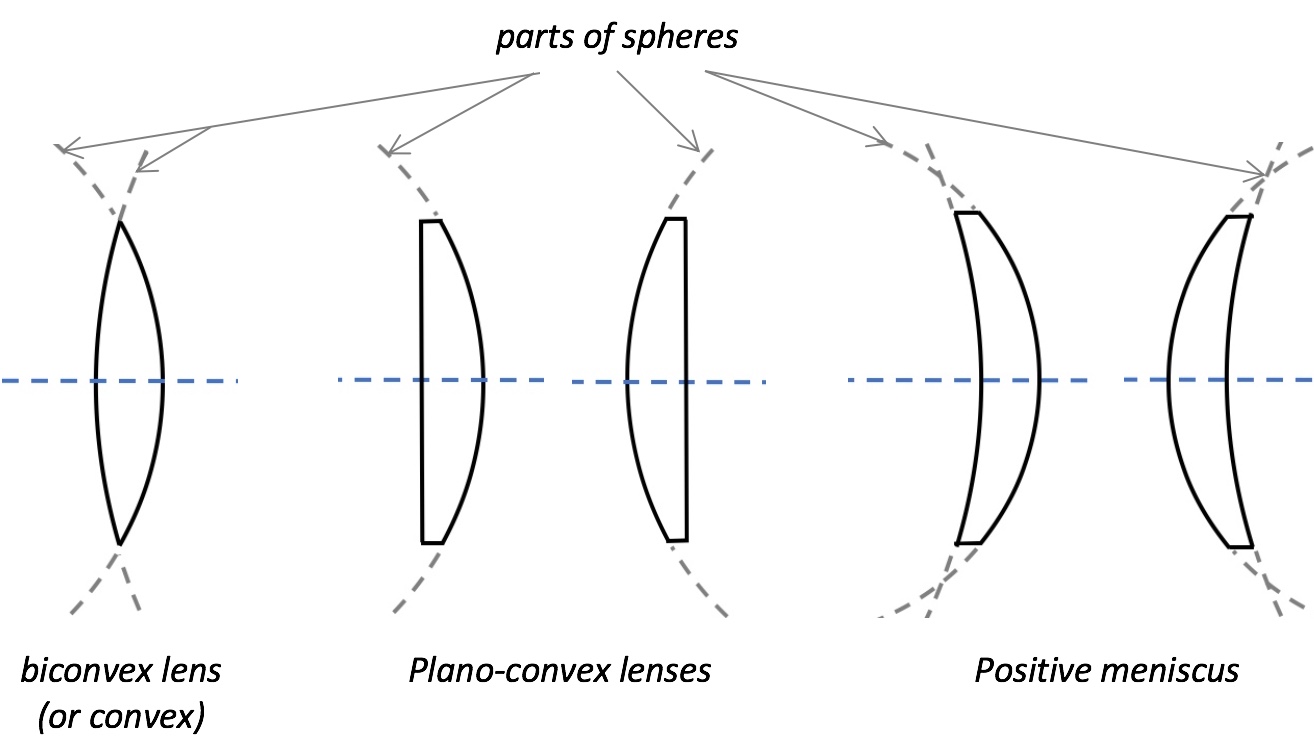
**Divergent lenses** = **negative lenses**
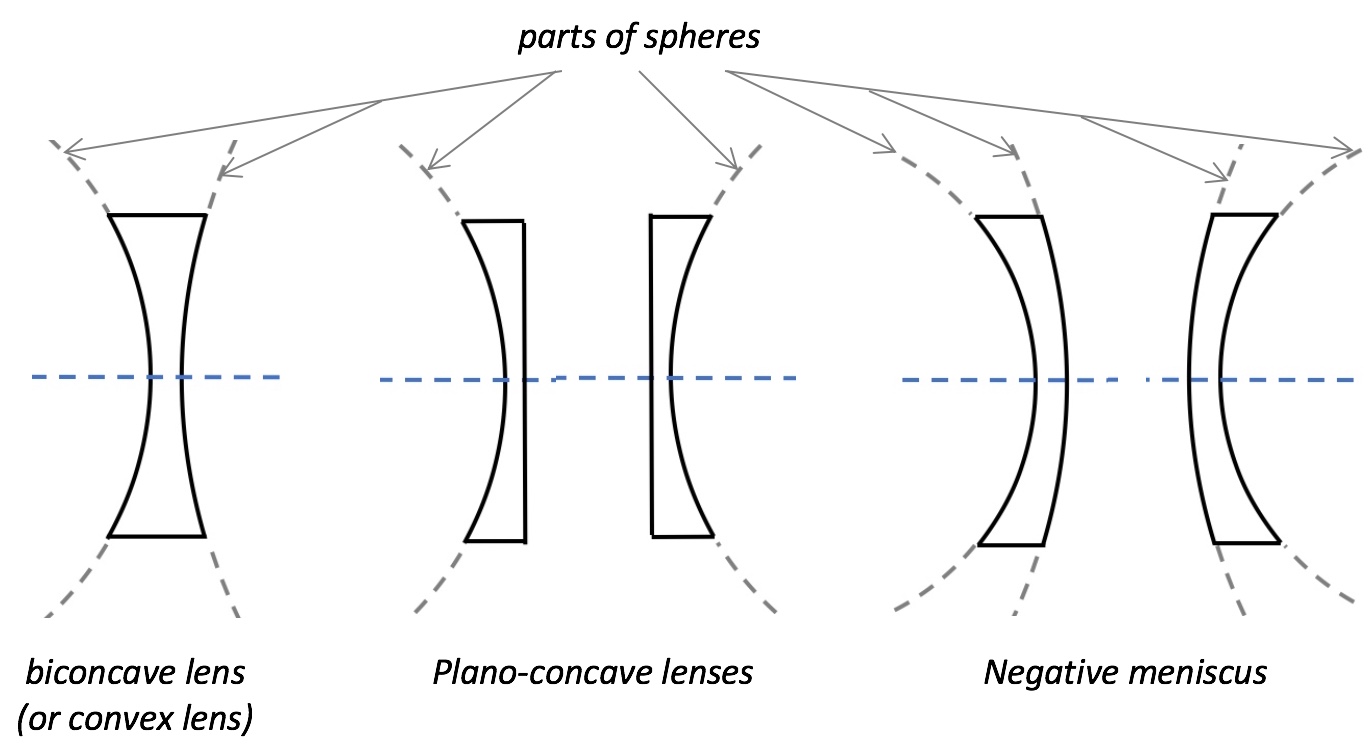
### Brief chronology
### Modeling a lens
#####