---
title: 'lensball : beyond'
published: true
vissible: true
media_order: 'lentille-boule-orleans-1bis.jpg,lensball-brut-820-760.jpg,Einstein-ring-free.jpg'
---
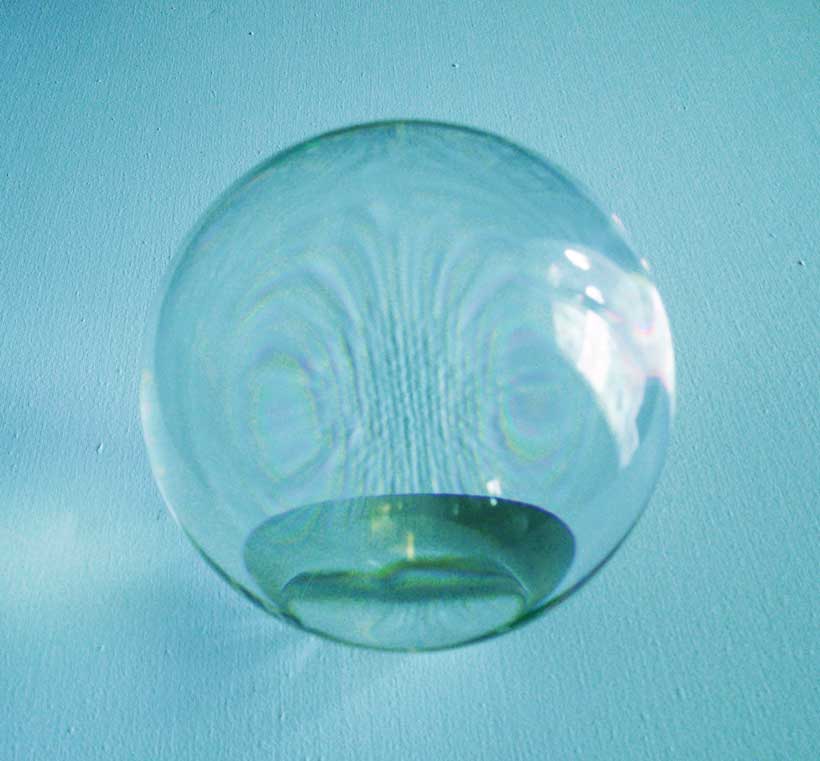
! *YOUR CHALLENGE* : Looking at a cathedral through a lensball. Can you predict your observation?
!
! 
!
! *Discovery time : 2 hours*
! *Resolution time : 30 minutes*
!
!
! I choose it
!
! A lensball is a polished spherical ball of radius $`R=5 cm`$, made of glass of refractive
! index value $`n_{glass}=1.5`$. The cathedral is 90 meters high, and you stand with the lensball
! 400 meters from the cathedral. You look at the cathedral through the lens, your eye being at 20 cm
! from the center of the lens. What would you expect to see?
!
! * _The resolution time is the typical expected time to be allocated to this problem if it was part
! of an examen for an optics certificate_.
!
! * _The discovery time is the expected time you require to prepare this challenge if you don't
! have practice. However, this is just an indication, take as much time as you need. The time to
! question yourself serenely about how to handle the problem, about the method of resolution and
! its validity, about some possible approximations if they can be justified, and the time
! you need to check the equations if you have not previously memorised them and to perfom
! the calculation, are important._
!
!
!
! Ready to answer M3P2 team questions ?
!
!
!
!
! What is the scientifical framework you choose to study this problem ?
!
! * All the characteristic sizes in this problem are much bigger than the wavelength of
! the visible radiation ($`\lambda\approx5\mu m`$), so I deal with this problem in the framework
! of geometrical optics, and in the paraxial approximation in order to characterize the image.
!
! * The cathedral sustains an angle of $`arctan\dfrac{90}{400}=13°`$ from the lensball.
! This value seems reasonable to justify at first order the use of the paraxial approximation
! (_we usually consider that angles of incidence would not exceed 10° on the various simple_
! _optical element encountered between the objet (here the cathedral) and the final image_
! _(retina of the eye or matrix sensor of a camera_).
!
!
!
!
! Describe the optical system for this use of the lensball.
!
! * The lensball breaks down into two refracting spherical surfaces sharing the same
! centre of curvature C and of opposite radius (in algebraic values).
!
!
!
!
! What is your method of resolution ?
!
! * You don't use general equations 3a and 3b for a thick lens, they are too complicated to remind,
! and you don't have in m3p2 to "use" but to "build a reasoning". And you don't know at this
! step how to handle with centered optical systems.
!
! * But this system is simple, so you will calculate the image of the cathedral by the
! first spherical refracting surface $`DS_1`$ encountered by the light from the cathedral
! $`DS_1`$. Then this image becomes the object for the second spherical refracting surface
! $`DS_2`$ and so I can determine position and size of the final image.
!
! * For a spherical refracting surface, general equations are :
! $`\dfrac{n_{fin}}{\overline{SA_{ima}}}-\dfrac{n_{ini}}{\overline{SA_{obj}}}=\dfrac{n_{fin}-n_{ini}}{\overline{SC}}`$
! for the position.
! $`\overline{M_T}=\dfrac{n_{ini}\cdot\overline{SA_{ima}}}{n_{fin}\cdot\overline{SA_{obj}}}`$
! for the transverse magnification.
!
!
!
!
! How do you set down your calculations?
!
! * The optical axis is the straight line that joins the center C of the lens to my eye,
! positively oriented in the direction of light propagation light for that observation,
! so from the cathedral to my eye.
! * First spherical refrating surface $`DS1`$ : $`\overline{S_1C_1}=+5\:cm`$, $`n_{ini}=1`$
! (air) and $`n_{fin}=1.5`$ (glass).
! Second spherical refrating surface $`DS2`$ : $`\overline{S_1C_1}=-5\:cm`$, $`n_{ini}=1.5`$
! (glass) and $`n_{fin}=1`$ (air)
! Distance between $`DS1`$ and $`DS2`$ vertices : $`\overline{S_1S_2}=+10\:cm`$
! Object cathedral $`AB`$ : $`\overline{AB}=90\;m`$ and $`\overline{S_1A}=-400\;m`$
! Let us write $`\overline{A_1B_1}`$ the intermediate image (the image of the cathedral given by $`DS1`$.
!
! * Specific equations for $`DS1`$ are :
! $`\dfrac{1.5}{\overline{S_1A_1}}-\dfrac{1}{\overline{S_1A}}=\dfrac{0.5}{\overline{S_1C_1}}`$ (équ. DS1a), and
! $`\overline{M_T}=\dfrac{\overline{S_1A_1}}{1.5\cdot\overline{S_1A}}`$ (équ. DS1b)
! Specific equations for $`DS2`$ are :
! $`\dfrac{1}{\overline{S_2A'}}-\dfrac{1.5}{\overline{S_2A_1}}=-\dfrac{0.5}{\overline{S_2C_2}}`$ (équ. DS2a), and
! $`\overline{M_T}=\dfrac{1.5\cdot\overline{S_2A'}}{\overline{S_2A_1}}`$ (équ. DS2b)
! The missing link between these two sets of equations is :
! $`\overline{S_2A_1}=\overline{S_2S_1}+\overline{S_1A_1}=\overline{S_1A_1}-\overline{S_1S_2}`$.
!
!
!
!
! Do you see some approximation that can be done ?
!
! * In the visible range, refractive index values of transparent material are in the range [1 ; 2],
! then the focal lengthes of a spherical refractive surface (object as well as image) are
! expected to remain in the same order of magnitude than the radius of curvature, so a few
! centimeters in this case (we talk in absolute value here).
!
! * We can if we want just check this fact for $`DS1`$ ($`|S_1C_1|=5\;cm`$) using équation DS1 :
! \- considering $`\overline{S_1A_1}\longrightarrow\infty`$ to obtain the object focal length
! $`\overline{S_1F_1}`$} we get :
! $`-\dfrac{1}{\overline{S_1F_1}}=\dfrac{0.5}{\overline{S_1C_1}}`$ $`\Longrightarrow=\overline{S_1F_1}=-10\;cm`$
! \- considering $`\overline{S_1A}\longrightarrow\infty`$ to obtain the image focal length $`\overline{S_1F'_1}`$ we get :
! $`\dfrac{1.5}{\overline{S_1F'_1}}=\dfrac{0.5}{\overline{S_1C_1}}\Longrightarrow\overline{S_1F'_1}=+15\;cm`$
!
! * The distance of the cathedral from the lensball $`|\overline{S_1A}|=90\;m`$ is huge compared
! to the object focal length $`|\overline{S_1F_1}|=10\;cm`$, we can consider that the cathedral
! is at infinity from the lensball and so the image $`\overline{A_1B_1}`$ of the cathedral
! stands quasi in the image focal plane of $`DS1`$ : $`\overline {S_1A_1}=\overline {S_1F'_1}=+15cm`$.
! So we can directly use equation DS2a with :
! $`\overline{S_2A_1}=\overline{S_2F'_1}=\overline{S_2S_1}+\overline{S_1F'_1}`$
! $`=\overline{S_1F'_1}-\overline{S_1S_2}=+15-10=+5\;cm`$..
!
!
!
!
!
! Where is the image and how tall it is ?
!
! * To perform calculation, you must choose a unic lenght unit in your calculation,
! here $`cm`$ or $`m`$. We choose $`m`$ below.
! * Equation DS1a gives :
! $`\dfrac{1.5}{\overline{S_1A_1}}-\dfrac{1}{-400}=\dfrac{0.5}{0.05}`$ $`\Longrightarrow\overline{S_1A_1}=0.15\;m`$
! With more than 2 significant figures, your calculator would tell you $`0.150037`$,
! which nearly exactly the value of $`\overline{S_1F'_1}=+0.15\;m`$, so the approximation
! $`\overline{S_1A_1}=\overline{S_1F'_1}`$ you could have done is fully justified.
!
! * Equation DS2a gives :
! $`\dfrac{1}{\overline{S_2A'}}-\dfrac{1.5}{-0.1+0.15}=\dfrac{-0.5}{-0.05}`$
! $`\Longrightarrow\overline{S_2A'}=0.025\;m`$
!
! * The final image is real, and stands 2.5 cm in front of the lensball in the side
! of your eye. Do not bring your eye or camera too close of the lensball \!
!
! * The size of an image (transversally to the optical axis) is given by the transverse
! magnification $`M_T`$. By Definition $`M_T`$ is the ratio of the algebraic size of the
! final image $`\overline{A'B'}`$ to the algebraic size of the initial object $`\overline{AB}`$.
! With an intermediate image, it can be break down :
! $`M_T=\dfrac{\overline{A'B'}}{\overline{AB}}`$
! $`=\dfrac{\overline{A'B'}}{\overline{A_1B_1}}\times\dfrac{A_1B_1}{\overline{AB}}`$
! It is the product of the transverse magnifications of the cathedral introduced by the
! two spherical refracting surfaces of the lensball.
! $`\overline{M_T}`$ introduced by $`DS1`$ is
! $`\overline{M_T}=\dfrac{\overline{S_1A_1}}{1.5\cdot\overline{S_1A}}`$
! $`=\dfrac{+0.15}{1.5\times(-400)}=-0.00025`$
! $`\overline{M_T}`$ introduced by $`DS2`$ is
! $`\overline{M_T}=\dfrac{1.5\cdot\overline{S_2A'}}{\overline{S_2A_1}}`$
! $`=\dfrac{1.5\cdot\overline{S_2A'}}{\overline{S_1A_1}-\overline{S_1S_2}}`$ $`=\dfrac{1.5\cdot0.025}{+0.15-0.10} =0.75`$
! So $`\overline{M_T}`$ introduced by the lensball is :
! $`\overline{M_T}=-0.00025\times0.75`$ $`=-0.00019\approx-1.9\cdot10^{-4}`$
! The image is $`\dfrac{1}{-1.9\cdot10^{-4}}\approx5300`$ smaller than the cathedral.
! $`M_T=\dfrac{\overline{A'B'}}{\overline{AB}}\approx8\cdot10^{-4}`$
! $`\Longrightarrow\overline{A'B'}=\overline{AB} \times M_T`$ $`=1.9\cdot10^{-4} \times 90\;m=-0.017\;m`$
! The image is 1.7 cm height and it is reversed.
!
!
!
!
!
! What is the apparent magnification of the cathedral ?
!
!
! * "apparent magnification" = "angular magnification" = "magnifying power".
!
! * As calculated previously, standing 400 metres from the cathedral, the 90 m heigh
! cathedral sustends the apparent angles of $`\alpha=arctan\left(\dfrac{90}{400}\right)=0.221\;rad=12.7°`$
! at your eye.
!
! * The image of the cathedral is 1.7 cm heigth and is located between the lens
! (from its vertex $`S2`$) and your eyes and at 2.5cm from the lens. If your eye is 20cm
! away from the lens, so the distance eye-image is 17.5 cm (we use no algebraic values).
! Thus the image of the catedral subtends the apparent angle
! $`\alpha'=arctan\left(\dfrac{1.7}{17.5}\right)=0.097\;rad=5.6°`$ at your eye.
!
! * The apparent magnification $`M_A`$ of the cathedral throught the lensball for my
! eye in that position is
! $`M_A=\dfrac{\alpha'}{\alpha}=\dfrac{0.097}{0.221}=0.44`$.
! Taking into account that the image is reversed, the algebraic value of the apparent
! magnification is $`\overline{M_A}=-0.44`$.
!
! * You could obtained directly this algebraic value of $`M_A`$ by considering algebraic
! lengthes and angles values in the calculations :
! $`\overline{M_A}=\dfrac{\overline{\alpha'}}{\overline{\alpha}}`$
! $`=\dfrac {arctan\left(\frac{-0.017}{-0.175}\right)} {arctan\left(\frac{90}{-400}\right)}`$
! $`=\dfrac{0.097}{-0.221}=-0.44`$
!
! 
! _Cathedral of Orleans (France)_
!
!
!
!
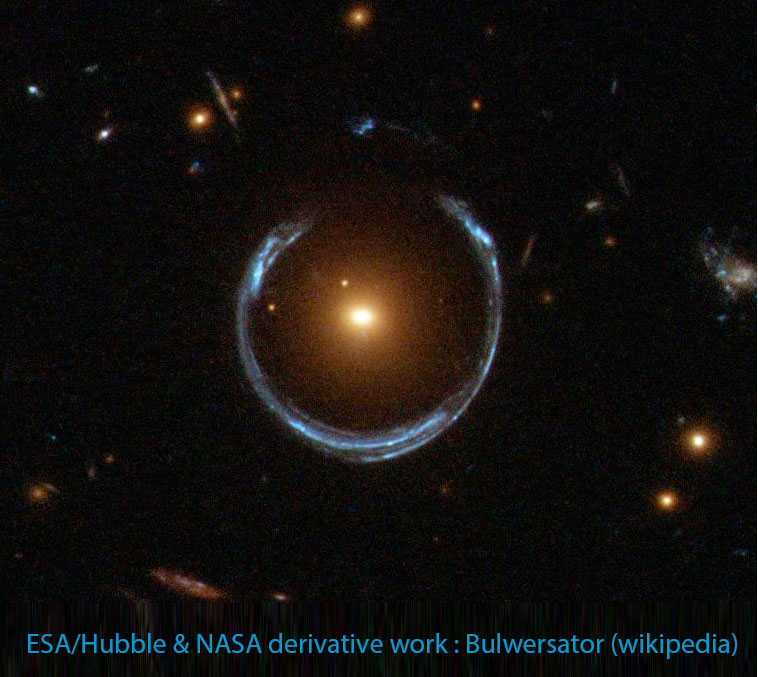
!! *BEYOND* : The gravitationnal lensball (or Einstein's ring), due to a black hole or a galaxy.
!! Similarities, and differences.
!!
!! 
!!
!!
!!
!! To see
!!
!! still to be done, in progress.
!!
!!!! *DIFFICULT POINT* (contribute, or indicate a difficult point of understanding)
!!!!
!! *CULTURAL POINT* (contributor)
!!
!!! *DO YOU MASTER ?*
!!!
!!!
!!! Describe the test
!!!
!!! The text of the test (and its images, figures, audio, video, etc ...)
!!!
!!! Question text
!!!
!!!
!!! Answer choice 1
!!!
!!! Text if this answer 1 is chosen
!!!
!!!
!!!
!!! Answer choice 2
!!!
!!! Text if this answer 2 is chosen
!!!
!!!
!!! -----
!!!
!!!
!!! Complete solution.
!!!
!!! text of the solution
!!!