
2.4 KiB
| title | media_order |
|---|---|
| Wave or corpuscules? or both ... | corpuscule-trajectory-tennis-ball.jpg,refraction-cuillere.jpg,sky-light-rays-827.jpg,wave-corpuscular-nature-of-light-experiment1.gif,waves-interferences-surface-water-827-496.jpg,reflexion-statuette.jpg |
How do we understand our physical world ?
- We interpret the world with two intuitive concepts that are in our mind mutually exclusive : the concept of corpuscule and the concept of wave
Localized corpuscules with trajectories
In our mind, a corpuscule is localized in space, and At each instant can be characterized by :
- a position in space
- a speed
- an acceleration
It carries :
- matter
- energy
- momentum
Between two instants, its movement describes a trajectory : continuous set of positions followed by the corpuscule between these two instants.
The behavior of a corpuscule at human scale, and their interactions with each other, is well described and predicted by classical mechanics.
- classical mechanics = Newton's mechanics = point mechanics

Waves that interfer to each other
In our mind, a wave is not localized in space, and in the whole time can be characterized by :
- a frequency
- a velocity
- frequency + velocity $\Longrightarrow$ a wavelength
- an amplitude
- a polarization (depending of wave type)
A wave
- does not carry matter
- carries energy
Several waves interfer with each other, giving rise to interferences
A wave passing through a small aperture (of size of the order or small than wavelength) is diffracted

How light behaves ?

A modern Youngs'type experiment : behavior of light passing through two slits and The light emerging from a double slit, whose the width (of each slot) and the spacing (between the two slots) are sufficiently small,
What optical phenomena do we observe in everyday life ?
- The light describes in straight lines in air.
$\Longrightarrow$ concept of light ray

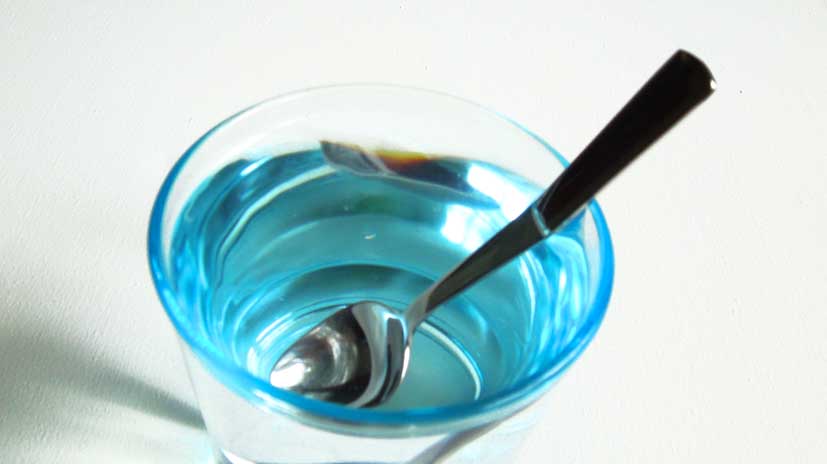
Refraction phenomenon
-
The light seems to change direction from water to air.
-
can be d
Reflection phenomenon
