
9.6 KiB
| title | published | routable | visible | lessons |
|---|---|---|---|---|
| Brainstorming partie "au-delà" | true | true | false | {slug brainstorming-3-parts} {order 3} |
Brainstorming partie "Au-delà"
Un rappel de ce qui est annoncé sur les 3 parties de cours est à :
https://m3p2.com/fr/m3p2_pedagogy/m3p2-pedagogy
1 - Ce dont nous disposons actuellement
Déjà décrit dans le brainstorming de la partie "Principal".
2 - Brainstorming pour cette partie "au-delà" de cours
Les différents propositions sont numérotées : elles commencent par :
[BB-numéro] : Titre
(BB pour Brainstorming Beyond)
-
Pour réagir à une proposition existante, rajouter votre commentaire à la suite des autres en commençant par trois initiales entre parenthèse vous représentants :
(CLM) : commentaire d'untel
(mes initiales) : mon commentaire -
Pour ajouter une proposition, créez là dans ou à la suite (suivant la logique de la proposition) des propositions existantes. Pour cela, commencer par un nouveau [BB-numéro] : Titre
[BB-10] Élément de style.
(CLE) Les fichiers de cours de chacune des trois parties sont différenciés (textbook pour la partie princiale,
cheatsheet pour la partie synthèse, annex pour la partie au-delà). Pour l'instant aucune personnalisation,
aucune feuille de style spécifique n'est appliquée à ces types de fichier.
Nous pourrons personnaliser plus le style de chaque partie pour mieux les différencier et identifier.
Mais déjà, une idée à tester.
Sur le premier prototype, le fond de cette partie au-delà était très légèrement colorée d'un violet clair.
A tester et choisir entre nous.
[BB-20] Différents éléments.
(CLE) C'est la partie qui permet :
- de dire tout ce qu'on a pas le temps de dire dans des cours classique, mais qu'on rêverait de dire et qui pourrait motiver plus les étudiants (au-delà de la simple acquisition de connaissances et compétences).
- de renforcer les explications sur des points particuliers et aïgus de cours (petites vidéos très courtes?)
- de proposer des défis sur plusieurs jours, pour que l'apprenant puisse réfléchir à un sujet proposé en dehors du temps d'apprentissage devant l'écran (par exemple réfléchir à la localisation d'une image en réflexion, en faisant attention à ce qu'on voit en réflexion dans la vitre d'un métro...)
- proposer des questionnaires, ou petits exercices de compréhension ou permettant d'acquérir des réflexes (écrit en javascript par exemple)
- proposer des problèmes représentatifs des examens.
Pour organiser ces éléments, il faut les regrouper dans un petit nombre de catégories facilement identifiables.
Sont proposées les catégories suivantes, mais à débattre :
!!! DO YOU MASTER ? !!!
!!! Describe the test. !!!
!!! Texte du test (et ses images, figures, audio, video, etc ...) !!! ! [a figure for the test] (file-name) !!! !!! Texte de la question !!!!!! Choix de réponse 1 !!!
!!! Texte si la réponse 1 est choisie !!!!!! Choix de réponse 2 !!!
!!! Texte si la réponse 2 est choisie !!!Exemples de défis
! YOUR CHALLENGE : An object (a painting), a physical system (a lensball), how many scenarios and optical systems?
!
! 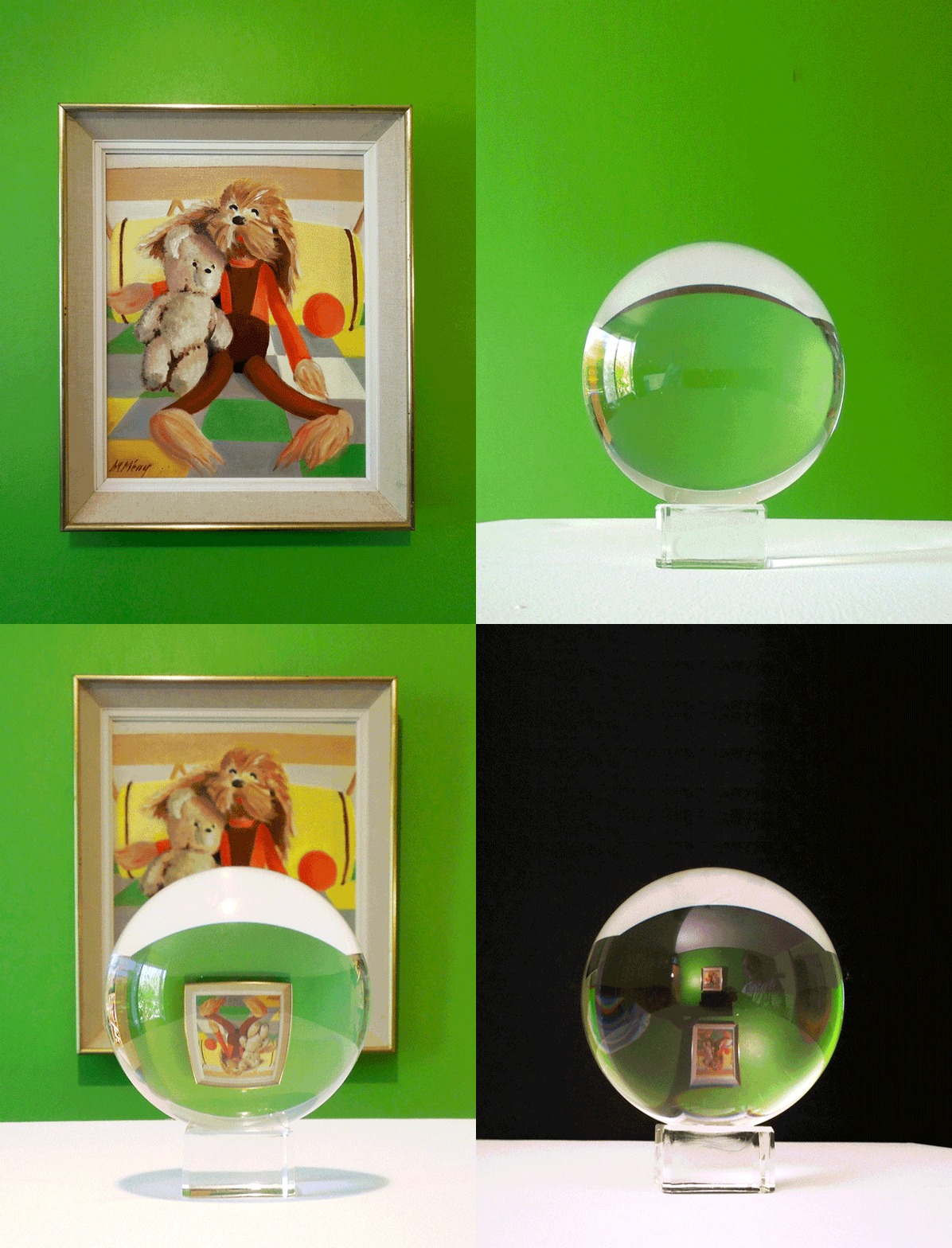 !
! Discovery time : 30 minutes
!
! Discovery time : 30 minutes
! Resolution time : 10 minutes
!
! I choose it ! !
! A lensball is a simple physical system: a sphere of glass of refractive index $n=1.5$ and of radius $R=5\;cm$.
!
! A ball lensball is placed in front of a painting. Depending on the position of the observer or the camera,
! the optical system (the sequence of simple optical elements crossed by light between the physical object
! and the observed image) that forms the image differs.
!
! Observe the 3 images of the painting given by the lensball :
!
! Image 1
!
!  !
! Images 2 (the smallest) and 3
!
!
!
! Images 2 (the smallest) and 3
!
!  !
! For each image of the painting, can you identify the optical system, then specify
!
! For each image of the painting, can you identify the optical system, then specify ! the characteristics of the various simple elements that constitute the system and their relative distances? ! ! * _The resolution time is the typical expected time to be allocated to this problem if it was part of an examen for an optics certificate._ ! * _The discovery time is the expected time required to prepare this challenge if you don't have practice. But take as much time as you need._ ! ! <\details> ! <details markdown=1> ! <summary> ! Ready to answer M3P2 team questions for image 1? ! </summary> ! ! <details markdown=1> ! <summary> ! Where is the painting located? ! </summary> ! * The painting is located on the other side of the lens, in relation to you. ! </details> ! <details markdown=1> ! <summary> ! What is the optical system giving the image of the painting? ! </summary> ! * The optical system is composed of two spherical refracting surfaces, centered on the same optical axis. ! </details> ! <details markdown=1> ! <summary> ! How do you characterize each of the single optical elements that make up this optical system, and their relative distances? ! </summary> ! * The optical axis is oriented positively in the direction of light propagation (from the painting towards the lensball). ! ! * The first spherical refracting surface $DS1$ encountered by the light has the follwing characteristics :<br> ! $\overline{S_1C_1}=+|R|=+5;cm$ , $n_{ini}=1$ and $n_{fin}=1.5$ ! ! * The second spherical refracting surface $DS2$ encountered by the light has the follwing characteristics :<br> ! $\overline{S_2C_2}=-|R|=-5;cm$ , $n_{ini}=1.5$ and $n_{fin}=1$ ! ! * Algebraic distance between $DS1$ and $DS2$ is : $\overline{S_1S_2}=+10;cm$ ! </details> ! <details markdown=1> ! <summary> ! If you had to determine the characteristics of the image (position, size), how would you handle the problem? ! </summary> ! * $DS1$ gives an image $B_1$ of an object $B$. This image $B_1$ for $DS1$ becomes the object for $DS2$. $DS2$ gives an image $B'1$ of the object $B_1$ ! </details> ! </details> ! <!--FOR IMAGES 2 & 3--> ! ! <details markdown=1> ! <summary> ! ! Ready to answer M3P2 team questions for images 2 and 3? ! </summary> ! ! <details markdown=1> ! <summary> ! Where is the painting located? ! </summary> ! * The painting is located on the same side of the lens as you, behind you. ! </details> ! <details markdown=1> ! <summary> ! What are the two optical systems at the origin of the two images of the painting? And can you characterize each of the single optical elements (+ their relative distances) that make up each of these optical systems ? ! </summary> ! * A first optical system $OS1$ is composed of a simple convexe spherical mirror (the object is reflected on the front face of the ball lensball). Keaping the ioptical axis positively oriented in the direction of the incident light propagation on the lensball, the algebraic value of the mirror radius is : $\overline{SC}=+5;c$. ! * The second optical system $OS2$ is composed of three simple optical elements :<br><br> ! 1) The light crosses a spherical refracting surface $DS1$ with characteristics : $\overline{S_1C_1}=+|R|=+5;cm$ , $n_{ini}=1$ and $n_{fin}=1.5$. ! ! 2) Then the light is reflected at the surface of the last lensball interface that acts like a spherical mirror of characteristics : $\overline{S_2C_2}=-|R|=-5;cm$, $n=1.5$. ! ! 3) Finally the light crosses back the first interface of the lensball that acts like a spherical refracting surface those characteristics are : $\overline{S_3C_3}=+|R|=+5;cm$ , $n_{ini}=1.5$ and $n_{fin}=1$. ! ! Relative algebraic distances between the different elements of $OS2$ are : ! ! $\overline{S_1S_2}=+10;cm$ and $\overline{S_2S_3}=-10;cm`$
! ! Which image is associated with each of the optical systems? !
! * It is difficult to be 100% sure before having made the calculations. !! Why do we had to take the picture in the darkness, with only the painting illuminated behind the camera, to obtain images 2 and 3 ? !
! * At a refracting interface, part of the light incident power is refracted, and part is reflected. For transparent material like glass and for visible light, the part of the reflected power is small. If the room had been homogeneously illuminated, the images 2 and 3 of the painting on the wall behind the camera would have been faintly visible compared to the image of the front wall through the lensball. !!!!! DIFFICULT POINT (contribute, or indicate a difficult point of understanding) !!!!
!! BEYOND (to contribute) !!
!! CULTURAL POINT (contributor) !!
!!! DO YOU MASTER ? !!!